At the door, then inside
For centuries the binding part happened in the porch and the blessing followed indoors. The split tells you which part was legal and which was religious.
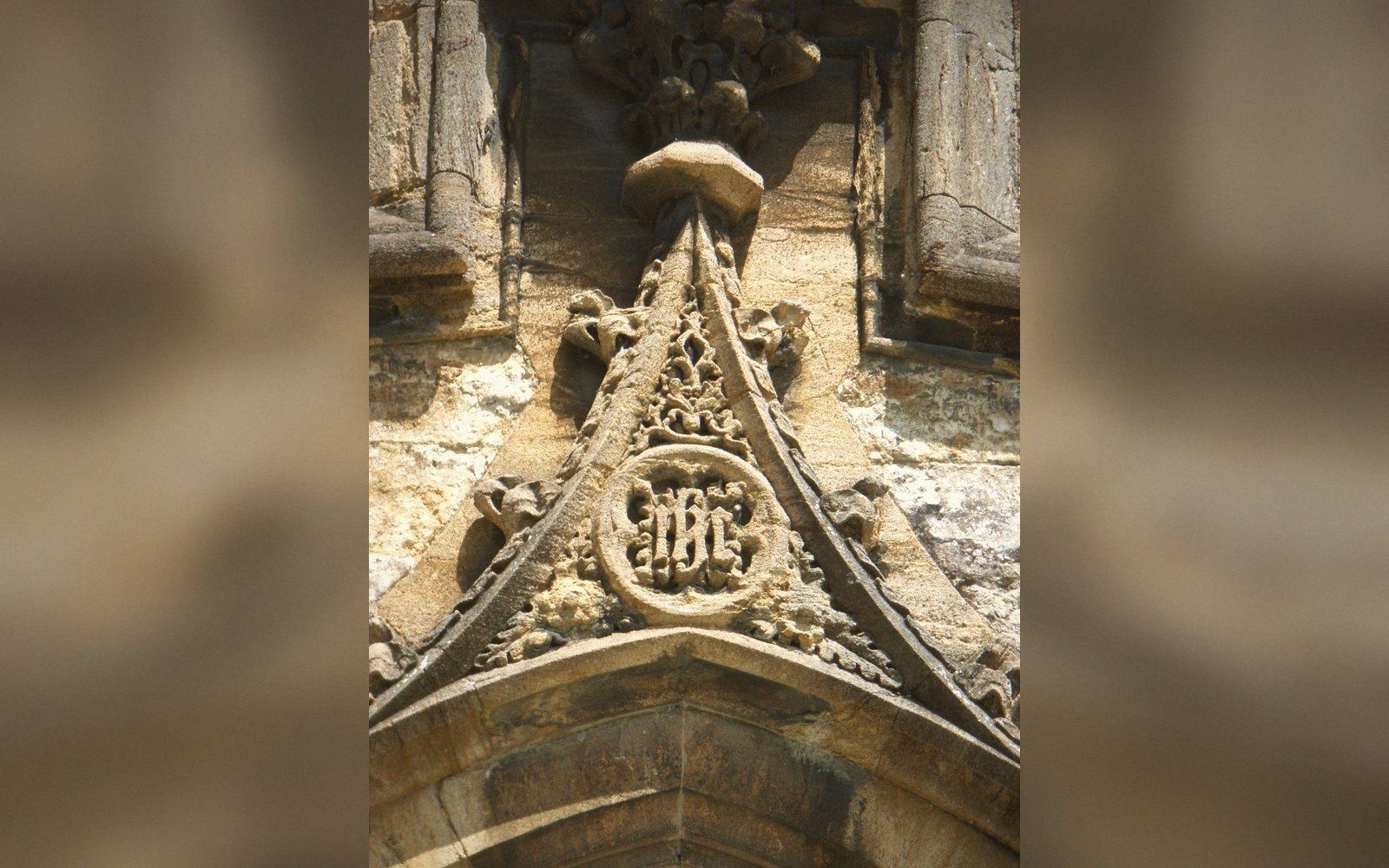
The threshold that divided law from blessing
For most of the medieval period, an English church wedding happened in two distinct places. The binding exchange — the vows, the ring, the joining of hands — took place at the church door. The mass, if there was one, followed inside. That division was not incidental to the ceremony. It was the ceremony's whole logic.

The porch, or the space before it, was public ground. Anyone passing could hear the words spoken. The priest stood facing the couple on the threshold, the congregation at their backs, the open street or churchyard behind them. When the groom placed the ring on the bride's finger and spoke his vow, it was witnessed by the community in the most literal sense: anyone who had an objection was, in theory, already present to make it. Canonical and common law both required that a marriage be provable, and a doorstep exchange in broad daylight was as provable as anything got.
This is why the church porch was, for centuries, a juridical space as much as a sacred one. Wills were read there. Contracts were sworn there. Debt acknowledgements were witnessed there. The marriage rite belonged to the same category of public legal act. The priest's role in this portion was closer to notary than celebrant — he read the words, checked for impediments, received the ring from the groom and handed it over — but he was not yet performing a sacrament. That came later, and indoors.
What the indoor part added
Once the door exchange was complete, the couple moved inside for the nuptial mass. This was where the Church's own theology of marriage came into play. The Sarum Rite — the liturgical use that dominated English practice before the Reformation — included a specific blessing of the couple during the mass, often with the bride and groom kneeling beneath a canopy or veil held over them by attendants. The blessing was the Church's benediction on the union, not its constitution of it. The union already existed, formed the moment the vows were exchanged at the door.
The priest stood facing the couple on the threshold, the congregation at their backs, the open street or churchyard behind them.
This two-part structure reflected a genuine theological position: marriage was made by consent, not by priestly action. The Church had debated this for centuries, with canonists distinguishing between matrimonium initiatum (a marriage begun, by betrothal or promise) and matrimonium ratum (a ratified marriage, completed by consummation). The door vows were the hinge. What happened inside the nave was confirmation and sanctification, not the act itself.
The Reformation collapsed the two-part ceremony in England. The 1549 Book of Common Prayer moved the entire rite inside the church, partly because Protestant theology was more suspicious of the half-secular, half-sacred space the porch represented. The doorstep exchanged its juridical function for the register, the witness, the banns. But the old structure persisted in popular imagination long after its formal abolition — and in some continental Catholic practice, the division between an external civil form and an interior religious ceremony survives in recognisable shape to this day.
Why the split still matters as a record
The legal consequence of the door-inside division was that the binding act needed no priest at all, strictly speaking. A man and woman who exchanged vows using words of present consent — I take thee rather than I will take thee — had, in canon law, married each other, regardless of where they stood or who was listening. Clandestine marriages, which plagued English ecclesiastical courts for centuries, exploited exactly this principle. The banns existed to prevent secret unions; the Hardwicke Act of 1753 finally required a church ceremony and registration precisely because the door-exchange principle had been so thoroughly abused.
What the old ceremony made visible, in its division of spaces, was the distinction between the legal act and the religious rite — a distinction that later centuries buried under a single ceremony indoors, performed by a person licensed to conduct both at once. The porch survives in most English churches, built for a function it no longer serves. The indoor ceremony that replaced the two-part rite looks unified, but it is still carrying both halves — the consent and the blessing — compressed into one room.