Read aloud three times
Before the register, before the ring, there was a spoken announcement — repeated on three separate Sundays so that anyone in the parish who knew a reason the marriage should not happen could say so.
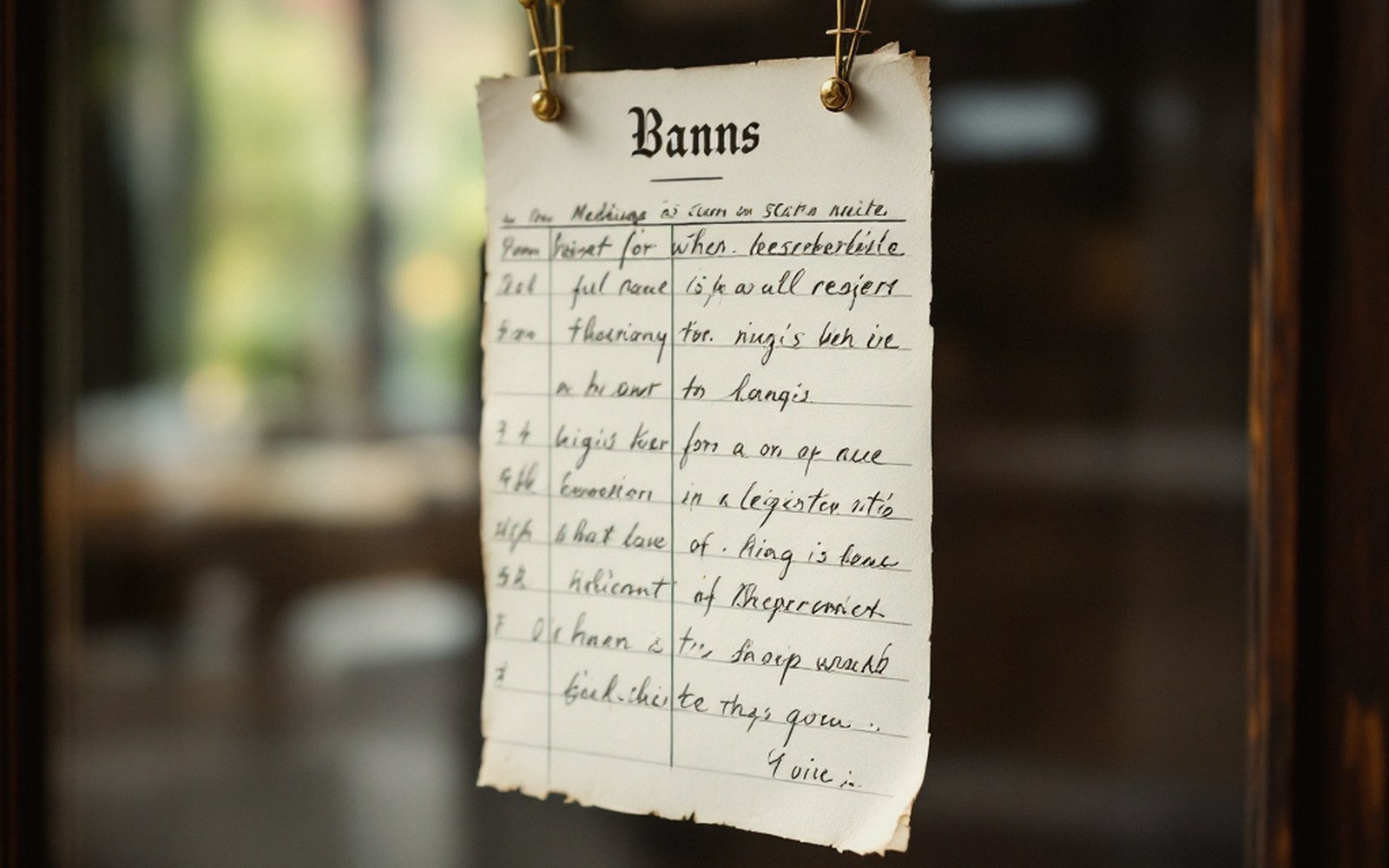
A spoken registry, before writing caught up
The banns — from the Old English gebann, a proclamation — were not a preamble to the legal act of marriage. For most of European history they were the legal act, or at least the thing that made a clandestine union a public one. The principle was simple: two people who intended to marry had their names read aloud in church, in the place where they were known, on three successive Sundays or feast days. Anyone who heard an impediment — an existing spouse, a degree of kinship too close, a minority, a prior betrothal — had an obligation to speak. Silence was consent, and three silences meant the marriage could proceed.

The formal requirement in England traces to the Fourth Lateran Council of 1215, which made the proclamation obligatory across the Western church. But the council was codifying something that had existed in looser form already: the idea that a community had standing to know about, and intervene in, the marriages of its members. This was not a sentimental principle. Marriage governed the transmission of property, the legitimacy of children, and the labour of households. A community that did not know who was joined to whom could not function as a community.
The three-Sunday rule had a practical rhythm to it. The readings had to be spread across at least three weeks, and each had to happen at a principal service when the congregation was largest — not a weekday low mass. If any Sunday was missed, the process had to begin again. This meant that the minimum engagement, measured in announcements, was three weeks, and the whole period could stretch much longer if a feast day or a local disruption intervened. In practice, the banns also had to be called in every parish where either party was resident, which could add weeks to proceedings if one of them had moved recently or held connections in a second parish.
Why marriages clustered in spring
The requirement to call banns intersected with the liturgical calendar in ways that shaped when marriages actually happened. Advent and Lent were both closed seasons: the church forbade solemnization of marriage during the penitential weeks before Christmas and Easter respectively. This meant that a couple who began their banns in mid-Lent could not marry until Easter week had passed, however efficiently the three Sundays were completed. Advent — roughly the four Sundays before Christmas — created the same blockage at the other end of the year.

The consequence, visible in parish registers from the sixteenth century onward, was a distinct clustering of marriages in the weeks immediately after Lent and immediately after Advent: late April and May on one side, January on the other, with a second peak in late autumn before the Advent embargo descended. Historians reading a run of registers can often identify these ecclesiastical rhythms without knowing the calendar — the pattern is that legible. A parish with a long marriage register from the seventeenth century will typically show thin columns for February, March and the first half of April, then a burst in the weeks after Easter Sunday.
There were also informal economic pressures running alongside the liturgical ones. Spring weddings could come before the heavy labour of summer, once the lean winter was over; autumn weddings could be held after the harvest was in and before the worst of the cold. The banns system did not create these pressures, but its calendar of closed seasons channelled behaviour into them.
For most of European history they were the legal act, or at least the thing that made a clandestine union a public one.
The objection that almost never came
Every account of banns emphasises the opportunity to object, but objections, when the records are examined, were rare. The kinds of impediment that a bystander could plausibly raise — an existing marriage, blood relationship, a prior betrothal — were not easily demonstrated on the spot. What a parishioner could do was speak to the incumbent privately, prompting an inquiry rather than a public confrontation at the church door. The incumbent had the authority to halt proceedings while the matter was investigated, and if the objection had substance, the case moved to the ecclesiastical court. If it did not, the banns resumed.

The more common evasion was not a fraudulent marriage but a hasty one: a couple who did not want to wait three weeks, or did not want their intentions publicly known, could obtain a licence — a document issued by a bishop or his surrogate that dispensed with the banns entirely. Licences cost money, they required a sworn allegation that no impediment existed, and they usually required a bond of surety from a guarantor. They were used by those who could afford them and who had reasons for speed or privacy: a widow remarrying, a couple with a considerable age gap, or anyone anxious about the scrutiny that three public readings would invite. By the eighteenth century the licence had become the preferred instrument among the propertied classes throughout England, and the banns retained their hold mainly in rural and poorer urban parishes where the fee was prohibitive.
The Hardwicke Act of 1753, which came into force in England and Wales in 1754, imposed stricter requirements on the whole system: banns or licence, church of England ceremony, witnesses, register. It was the most significant legislative tightening of marriage law England had seen, and it made the called banns and the written register work together as interlocking parts of a single public record rather than parallel traditions. Scotland was excluded from the Act and retained its own laws; this is the structural reason that Gretna Green, just across the Scottish border, became the destination for English couples who could not or would not satisfy the Hardwicke requirements.

The civil registration of marriage, introduced in England and Wales in 1837, created a parallel secular route that did not require banns at all, though it created its own notice system — a superintendent registrar's notice posted for twenty-one days — that served the same purpose in a different office. The Church of England continued calling banns, and continues still. The form of words has changed very little. The names are read aloud, the congregation is asked whether they know any cause or just impediment, and silence is still the expected answer — as it has been, in almost every case, for eight hundred years.